These jobbies have been in the news lately, in particular on the BBC news site.
Which acted as a good reminder that I've been meaning to post about the Red Wheelies for months, but keep forgetting.
So here they are!
.
Saturday, 9 January 2010


Friday, 8 January 2010
"I Wouldn't Dare . . . "
Dr Werner Struth is president of Bosch's Chassis Systems Control Division, and responsible for considerable research into vehicle safety innovation.
However . . . I have to wonder about whether he's beginning to overlook the part a driver plays in avoiding crashes, when he's quoted as saying:
"I would not dare to travel in a car without an airbag."
.
However . . . I have to wonder about whether he's beginning to overlook the part a driver plays in avoiding crashes, when he's quoted as saying:
"I would not dare to travel in a car without an airbag."
.
Thursday, 7 January 2010
A post about . . . posts

It's no secret: motorcyclists crash. Trouble is, that they usually hit something other than the ground as part of the crashing process.
Often, that 'something' will be s signpost.
Signpost Solutions have come up with a low-cost padding option to cover particularly 'exposed' signposts, called the Biker mate.
SignPost Solutions have devised the Worlds first car and motorcycle friendly sign mast. The photograph shows the new ' Biker Mate ' device fitted to a Lattix passively safe mast which is the first time that both types of road user have been accomodated in one installation and offers a safe solution for each mode of transport when collisions occur.
Biker Mate can also be fitted to steel sign posts, signal pole, lighting columns and and wooden telegraph poles. The unique patented device is low cost and very simple to install and also remove/refit where neccessay for access to lighting column doors. Biker Mate is available with or without reflective material and comes in modular form so that any height can be achieved.
.
Wednesday, 6 January 2010
New Helmet Technology

It's not often that something 'new' comes along in the world of helmets.
Usually any 'innovations' are really just tweaks to materials (carbon fibre rather than fibreglass) or finish (scratch resistant ocatings on visors).
For some manufacturers a new colour scheme based on the helmet worn by a famous racer is reason enough to launch a publicity campaign.
Even something like Pin-Lock visors are really only a minor add-on - albeit a good one!
So I was interested to read about ThermaHelm.
What makes this so different? Well, simply (and in my layman's terms), it starts 'treatment' for head injury as soon as a rider has a crash!
However, they say:
ThermaHelm™ is a revolutionary brain cooling helmet technology that could save your life. Riding without ThermaHelm™ technology is like driving without an airbag.
Head injuries occur in 80% of all motorcyclist fatalities. A key factor in these injuries is brain swelling inside the helmet and the response time to address the issue. ThermaHelm™ technology helps to mitigate this problem by cooling the rider's head post-accident.
A standard helmet acts like an insulator. The polystyrene foam found in ALL motorcycle helmets is the same white foam that in installed in the walls of ALL refrigerators and portable coolers. It's the perfect energy absorber...and insulator. The helmet acts like an oven to an already hot, sweaty head causing post accident brain temperatures to potentially reach a fatal threshold. This is how motorcycle riders can die.
ThermaHelm™ technology works by triggering an endothermic chemical reaction inside the helmet lining at the moment of impact. The helmet immediately cools the motorcyclists head, keeping it cold even before the emergency services could have been called.
More info, news stories, videos and images on their web site: http://www.thermahelm.com/
.
Tuesday, 5 January 2010
Tuesday, 22 December 2009
Saturday, 19 December 2009
Independent Safeguarding Authority scheme
ATL union have a factsheet on their web site covering the new Independent Safeguarding Authority scheme.
This factsheet explores the framework for the new vetting and barring service, covering those working or volunteering with children or vulnerable adults
Download pdf
What's it about, why has it been brought in, and might it affect you if you're an instructor?
Following the Soham murders the government set up an Inquiry chaired by Sir Michael Bichard. The Inquiry published its report in 2004 and made 31 recommendations. One of the recommendations stated that:
“New arrangements should be introduced requiring those who wish to work with children, or vulnerable adults, to be registered. The register would confirm that there is no known reason why an individual should not work with those clients.”
The government accepted the recommendation and as a result enacted the Safeguarding Vulnerable Groups Act 2006 and the Safeguarding Vulnerable Groups(Northern Ireland) Order 2007.
Independent Safeguarding Authority
The Act set out the framework for a new vetting and barring service, covering those who work or volunteer with children (defined as those under the age of 18) and vulnerable adults. The scheme is to be fully introduced from 26 July 2010.
.
This factsheet explores the framework for the new vetting and barring service, covering those working or volunteering with children or vulnerable adults
Download pdf
What's it about, why has it been brought in, and might it affect you if you're an instructor?
Following the Soham murders the government set up an Inquiry chaired by Sir Michael Bichard. The Inquiry published its report in 2004 and made 31 recommendations. One of the recommendations stated that:
“New arrangements should be introduced requiring those who wish to work with children, or vulnerable adults, to be registered. The register would confirm that there is no known reason why an individual should not work with those clients.”
The government accepted the recommendation and as a result enacted the Safeguarding Vulnerable Groups Act 2006 and the Safeguarding Vulnerable Groups(Northern Ireland) Order 2007.
Independent Safeguarding Authority
The Act set out the framework for a new vetting and barring service, covering those who work or volunteer with children (defined as those under the age of 18) and vulnerable adults. The scheme is to be fully introduced from 26 July 2010.
.
Kid's Road Safety
Saturday, 5 December 2009
DSA on YouTube
DSA have recently added a Youtube 'channel' as a method for improving communication with the public and interested professionals.
Channel http://www.youtube.com/user/dsagov
.
Channel http://www.youtube.com/user/dsagov
.
Friday, 4 December 2009
Book!
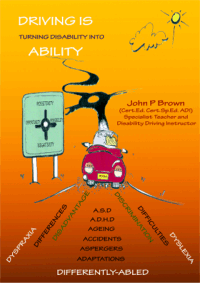
Some time ago I posted about John Brown's excellent book "Driving is more about Psychology than Systems".
He's now followed this up with: "Driving is turning Disability into Ability".
I haven't read the new book, but if it's anywhere near as good as the first, then it'll be useful.
If you're an ADI, trainer, or Observer, I thoroughly recommend the first book!
More details: www.drivingincludesu.co.uk
.
Thursday, 3 December 2009
Wednesday, 2 December 2009
Wet Wet Wet

Water has certainly been in the news lately, from the catastrophic floods in Cockermouth (a town I know well, and regularly visit; I've been in many of those flooded-out shops and pubs) to more localised downpours such as those we had Saturday evening.
As luck would have it, I was in the car, but it set me thinking . . .
Local Knowledge
There's an old saying that 'familiarity breeds contempt'. But used carefully, local knowledge can work for you. So it was that I was able to predict - from previous heavy rain - those locations where the road was likely to be submerged. I was right in some cases, wrong in others.
Stop Within the Distance You Can See To Be Clear
At times it was difficult to see very much - not helped by the driver in front deciding to have his rear fog light on . . . However, even staying 100 - 150m back, I was able to see how he (guessing) was reacting to the road ahead, and so when he braked firmly where there's usually no need it was a 'warning' for me.
Around the corner . . . and the road was submerged from verge to verge! 'parked' in it was a drowned car, accompanied by a breakdown van and a police car. Helpfully, the police had put out some 'arrow' signs - unhelpfully they had all their flashy lights going, it was difficult to see much as it was bouncing off every available wet surface.
See and Be Seen
Worse still, there was someone - I'm guessing police - stood in-line between where I had to drive and the police vehicle. Despite his hi-viz coat it was almost impossible to see hime due to the flood of bright lights.
Remember, kids, just because you can see someone it doesn't mean they can see you - however bright you are!
The Farmer Brown Test Revisited
You may have seen the 'Farmer Brown Test', which says: IF it looks stupid, it probably is, so don't do it.
A variation on 'too good [or cheap] to be true'
Another variation is: 'Just because it's smooth, flat and dark, doesn't mean it's a road'.
On the final (well, almost, but I wanted dramatic effect) roundabout before 'home' I realised just in time that what looked like a roundabout was actually a lake. I don't know what made me realise (although under street lights, remember this was in torrential rain, so the roads were already very wet), but it's a reminder to keep your speed down in such circumstances, and trust your 'spidey sense'.
Edit to add some more (and sort a couple of typos):
If you do have to pass through floods, try to determine whether the road has 'crown camber' (ie is higher in the centre between the opposing lanes) or 'super elevation' also known as 'cross fall' (where there is a slope from one side to the other). Knowing this can help you decide where the shallow water will be.
Then, keep your speed down to prevent a bow wave.
.
Tuesday, 1 December 2009
Regular Readers . . .
. . . May have noticed a [now missing] 'comment' appear on the end of a recent post.
I like reading your comments, you may think of a different 'twist' to how I see things.
However, this one was different, it was a blatant plug for a web site, complete with html link.
Now, such posts can be a legitimate way of advertising. In fact, if I'd received an email from the owner I might even have posted about the site.
But 'free' advertising for no contribution? No, sorry, Comment >>> 'Bin'.
But out of curiosity I had a look around the site . . . Advertising . . . If I want to advertise on their site, then a 'Button' is £25 per month.
Definately staying in the bin!
.
I like reading your comments, you may think of a different 'twist' to how I see things.
However, this one was different, it was a blatant plug for a web site, complete with html link.
Now, such posts can be a legitimate way of advertising. In fact, if I'd received an email from the owner I might even have posted about the site.
But 'free' advertising for no contribution? No, sorry, Comment >>> 'Bin'.
But out of curiosity I had a look around the site . . . Advertising . . . If I want to advertise on their site, then a 'Button' is £25 per month.
Definately staying in the bin!
.
Saturday, 28 November 2009
Compendium of motorcycling statistics - 2009 edition
On 29 October 2009 Transport Statistics, DfT, issued figures covering all types of two-wheeled motor vehicle transport, with the statistics presented in four sections: Motorcyclists (statistics on motorcycle ownership and training); Motorcycles (information about the vehicles and their characteristics); Journeys made (their number, purpose and characteristics); and Motorcycling safety (statistics on road accidents involving motorcycles). The key findings include:
• In 2008, just under 3% of households had at least one motorcycle, with about 1.3 million licensed motorcycles in Great Britain in 2008
• Of the 105,000 motorcycle tests carried out in 2008/09, 85% were taken by men
• Over a million motorcycles underwent an MOT test in 2008/09. Of these, 81% passed
• The distance driven by motorcycles in 2008 was 5.1 million vehicle kilometres, down 8% on 2007
• In 2008 the number of deaths or serious injuries involving motorcycles was 1,131 per billion kms driven. A decade earlier it was 23% higher
• In 2008, of the motorcycle drivers tested following an accident, only 1.4% failed a breathalyser test - significantly lower than the 2.7% rate for road users as a whole.
For queries concerning this publication, email Vehicle.Stats@dft.gsi.gov.uk
Info from: TRANSPORT STATISTICS USERS GROUP http://www.tsug.org.uk/
.
• In 2008, just under 3% of households had at least one motorcycle, with about 1.3 million licensed motorcycles in Great Britain in 2008
• Of the 105,000 motorcycle tests carried out in 2008/09, 85% were taken by men
• Over a million motorcycles underwent an MOT test in 2008/09. Of these, 81% passed
• The distance driven by motorcycles in 2008 was 5.1 million vehicle kilometres, down 8% on 2007
• In 2008 the number of deaths or serious injuries involving motorcycles was 1,131 per billion kms driven. A decade earlier it was 23% higher
• In 2008, of the motorcycle drivers tested following an accident, only 1.4% failed a breathalyser test - significantly lower than the 2.7% rate for road users as a whole.
For queries concerning this publication, email Vehicle.Stats@dft.gsi.gov.uk
Info from: TRANSPORT STATISTICS USERS GROUP http://www.tsug.org.uk/
.
Subscribe to:
Posts (Atom)

 Posts
Posts