If you're a regular reader, you may have seen several posts around the theme of vision and perception. If you're not and haven't, I'll leave you to read through the archives as well as read the next few posts.
While looking for something totally - almost, anyway - different, I happened across a site full of news links and short science/vision news.
Posting once, with text and links together won't make them easy to read, so I'll post them over the next few days.
.
Tuesday, 23 June 2009


Search
Study discovers clues into how eyes search
Like the robots in the "Terminator" movies, our eyes move methodically through a scene when seeking out an object. If we don't immediately find what we're searching for, our attention leaves the already-scanned area behind and moves on to new, unexplored regions of a scene, still seeking the target.
"Inhibition of return" -- in which our attention rarely or slowly returns to objects we've already looked at -- is what many believe makes visual search so efficient. But how do our eyes behave when we're not specifically hunting for something? A University of Nebraska-Lincoln-led research team recently found clues suggesting our vision, unlike those "Terminator" machines, can lock in on certain targets more quickly if they're not in search mode.
Mike Dodd, a UNL professor of psychology, worked with researchers from Utrecht University in the Netherlands and the University of Iowa in tracking eye movements as subjects viewed various scenes. Using high-tech equipment that followed eye movements in real time, researchers recorded where their subjects' attention was focused at each moment.
The participants were divided into four groups: One searched scenes for a specific target; one memorized each scene; one rated how pleasant the scenes were; and one was told to "free-view" the scenes -- to look anywhere they liked.
When a target would appear in the participants' line of sight -- either in an old location or in a spot where their eyes had yet to focus upon -- all four groups were instructed shift their eyes to the target. But the study's findings, published this month in Psychological Science, suggest that "inhibition of return" happens during visual search and not during other visual tasks.
That is, those in the group told to search for a specific object were slower to shift their eyes back to areas they had already examined. Those in the other three groups, however, had the opposite reaction. They shifted their eyes back much faster to areas they had already looked at than to new locations.
"This was surprising because people have often talked about inhibition of return being the default setting for attention," Dodd said. "Our results indicate that the exact opposite is true. People are actually faster to go back to previously viewed locations when they are doing anything other than search."
The practical importance of knowing how attention behaves is key to thinking about how to arrange the world around us. Simple applications could mean rethinking how to arrange maps, where to place street signs, or how to configure warning lights in cars or airplanes, he said. The information could also be applied to the design of vehicles and equipment to make them as user-friendly as possible.
"Anything we know about visual attention in the big picture is useful, making our findings important since it is in direct opposition to how people usually think attention works in most settings," Dodd said
From:
http://www.physorg.com/news164469120.html
.
Like the robots in the "Terminator" movies, our eyes move methodically through a scene when seeking out an object. If we don't immediately find what we're searching for, our attention leaves the already-scanned area behind and moves on to new, unexplored regions of a scene, still seeking the target.
"Inhibition of return" -- in which our attention rarely or slowly returns to objects we've already looked at -- is what many believe makes visual search so efficient. But how do our eyes behave when we're not specifically hunting for something? A University of Nebraska-Lincoln-led research team recently found clues suggesting our vision, unlike those "Terminator" machines, can lock in on certain targets more quickly if they're not in search mode.
Mike Dodd, a UNL professor of psychology, worked with researchers from Utrecht University in the Netherlands and the University of Iowa in tracking eye movements as subjects viewed various scenes. Using high-tech equipment that followed eye movements in real time, researchers recorded where their subjects' attention was focused at each moment.
The participants were divided into four groups: One searched scenes for a specific target; one memorized each scene; one rated how pleasant the scenes were; and one was told to "free-view" the scenes -- to look anywhere they liked.
When a target would appear in the participants' line of sight -- either in an old location or in a spot where their eyes had yet to focus upon -- all four groups were instructed shift their eyes to the target. But the study's findings, published this month in Psychological Science, suggest that "inhibition of return" happens during visual search and not during other visual tasks.
That is, those in the group told to search for a specific object were slower to shift their eyes back to areas they had already examined. Those in the other three groups, however, had the opposite reaction. They shifted their eyes back much faster to areas they had already looked at than to new locations.
"This was surprising because people have often talked about inhibition of return being the default setting for attention," Dodd said. "Our results indicate that the exact opposite is true. People are actually faster to go back to previously viewed locations when they are doing anything other than search."
The practical importance of knowing how attention behaves is key to thinking about how to arrange the world around us. Simple applications could mean rethinking how to arrange maps, where to place street signs, or how to configure warning lights in cars or airplanes, he said. The information could also be applied to the design of vehicles and equipment to make them as user-friendly as possible.
"Anything we know about visual attention in the big picture is useful, making our findings important since it is in direct opposition to how people usually think attention works in most settings," Dodd said
From:
http://www.physorg.com/news164469120.html
.
Tuesday, 16 June 2009
Motorcycle 'Safety' Web Sites
Did I say that one day I'll put a list of sites together?
Well, no real need - someone's already done it.
'Someone' is the IHIE - the Institue of incorporated Highway Engineers. And on a separate site they provide the IHIE Guidelines for Motorcycling, and a lot more information.
There's also a good summary of some of the varied bike safety campaigns and web sites that of been in place over the last few years.
More here.
.
Well, no real need - someone's already done it.
'Someone' is the IHIE - the Institue of incorporated Highway Engineers. And on a separate site they provide the IHIE Guidelines for Motorcycling, and a lot more information.
There's also a good summary of some of the varied bike safety campaigns and web sites that of been in place over the last few years.
More here.
.
Sunday, 14 June 2009
Bare Bones

One day I'll get around to compiling a list of all the various rider-oriented web sites.
Until then, here's Bare Bones.
Be warned: *Damage limitation: Be aware, graphic images are included on this website
The site is mainly about preventing injury. Not directly by preventing crashes, but by encouraging younger riders to be aware of the potential for injury from bike crashes.
.
Saturday, 13 June 2009
Conspicuous, Hi-Viz, Clothing Works!
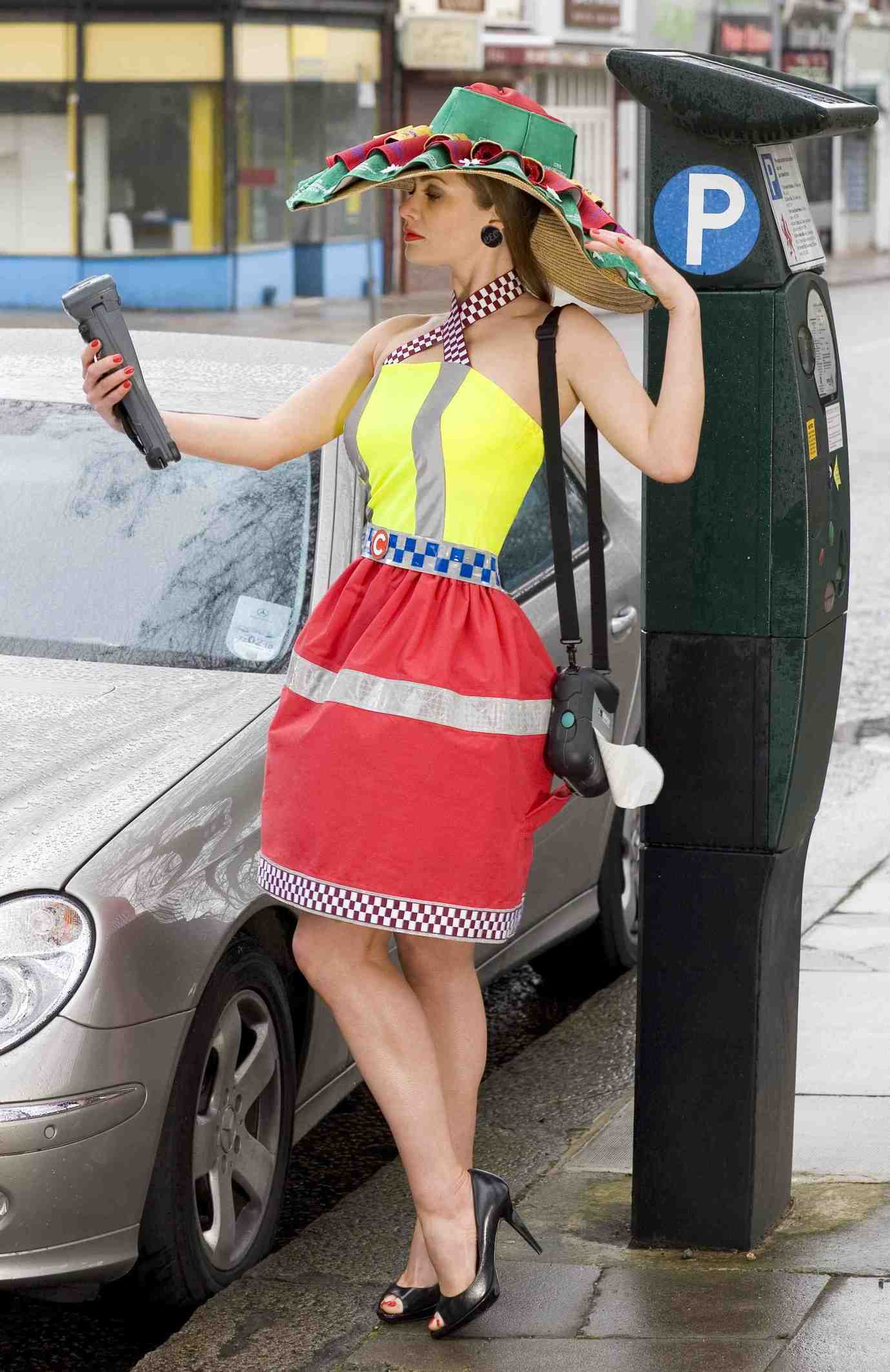
Well I certainly looked twice!
At the forefront of trends, Managing Director of Fashion Systems, Freddie Magumba brings a fresh approach to clothing in the parking industry.
Inspired by Vivienne Westwood, Freddie has designed a frock using the latest materials to highlight his creative approach to uniform design. Flourescents are definitely in this year! But don’t worry, before you start imagining traffic wardens doing a Beckham in headbands and sarongs, Fashion Systems are just making a point – uniforms don’t have to be boring and a truly creative approach can have huge impact on Parking Enforcement.
A recent re-design of Westminster City Council’s Civil Enforcement Officers’ uniform had a dramatic effect on reducing verbal abuse and attacks on staff – a 75% drop. Fashion Systems created a more casual outfit incorporating a baseball style cap and a bomber-style blouson jacket with reflective stripes. Westminster was the first council in the UK to make this bold move which has prompted other councils to review their uniforms.
.
Friday, 12 June 2009
Shakespeare on Road Safety
Like most things, sooner or later there's a quote from the Bard which fits the bill!
In his book 'Traffic Safety and the Driver', Leonard Evans writes about human behaviour, that we change our response according to the preceived probability and severity of harm.
He continues: "We walk more carefully when the ground is wet or icy than when it is dry; we walk more carefully on rough surfaces when barefoot than when wearing shoes. A warrior may accept a greater risk of being struck by a weapon than one not so clad, and so on. Shakespeare writes, "Best safety lies in fear" [Hamlet., Act I, Scene 3]."
.
In his book 'Traffic Safety and the Driver', Leonard Evans writes about human behaviour, that we change our response according to the preceived probability and severity of harm.
He continues: "We walk more carefully when the ground is wet or icy than when it is dry; we walk more carefully on rough surfaces when barefoot than when wearing shoes. A warrior may accept a greater risk of being struck by a weapon than one not so clad, and so on. Shakespeare writes, "Best safety lies in fear" [Hamlet., Act I, Scene 3]."
.
Advanced Driver TRAINing?

From BBC News
A drunk woman who drove almost half a mile along railway tracks before her car broke down has been spared jail.
Alcoholic Karen Angus had downed wine and taken anti-depressants before she somehow turned on to the tracks at a Metro crossing in Fawdon, Newcastle.
The mother-of-three said she could not remember driving and, when arrested, told police she was having a "bad day".
Angus, 40, who admitted endangering rail travellers, was given a 10-month prison term, suspended for two years.
On 24 February, she was spotted by the driver of a Metro train carrying 20 passengers on the opposite side of the tracks, Newcastle Crown Court heard.
Prosecutor Debbie Breen said: "At about 11pm the Metro driver Alistair Joel saw headlights appear on the other side of the track.
"He slowed down and saw there was a motor vehicle on the track and applied the emergency brakes."
The judge told Angus she was lucky to be alive
The driver walked down the track to the car, where Angus wound down the window and told him: "I'm an alcoholic, My car won't start."
Judge David Wood also gave Angus a 12-month supervision order and banned her from driving for three years.
.
Thursday, 11 June 2009
Training Videos from Around the World
Have we had many British videos featuring police training, riding and driving?
Let's have a couple:
This is segment one from the Fuel Show 12/17/06. In the News segment we look at the UK police at Volvo driving school.
Advanced Motorcycle Riding with Mike Waite: Ex-Police Motorcycle Instructor
Produced for Devon & Cornwall Police as part of a driver safety campaign, this promo puts you right alongside a police motorcyclist attending a 999 call.
The International police rally and Pride instructor Gordon KEMP
(Listen to the 'commentary')
This is EDUCATIONAL footage I found from a Bikeafe video 1999. It features a Police motorcyclist from Thames Valley, filmed from a helicopter and commentary put on afterwards. Great clip.
Features the late Phil Curtis
.
Let's have a couple:
This is segment one from the Fuel Show 12/17/06. In the News segment we look at the UK police at Volvo driving school.
Advanced Motorcycle Riding with Mike Waite: Ex-Police Motorcycle Instructor
Produced for Devon & Cornwall Police as part of a driver safety campaign, this promo puts you right alongside a police motorcyclist attending a 999 call.
The International police rally and Pride instructor Gordon KEMP
(Listen to the 'commentary')
This is EDUCATIONAL footage I found from a Bikeafe video 1999. It features a Police motorcyclist from Thames Valley, filmed from a helicopter and commentary put on afterwards. Great clip.
Features the late Phil Curtis
.
Wednesday, 10 June 2009
"Wot'll It Do, Mister?"
The question regularly asked by kids, as they stare at your bike's speedo, blissfully ignorant that the manufacturers have optimistically given your bike a speedo that potentially reads far faster than the bike will ever go.
But park either of this machines, and you'll get other riders asking "What the hell is that?"
While looking at the Lucky 13 cartoons, I followed a 'news' link on the ACEM site.
YAMAHA FC Dii fuel cell prototype

YAMAHA's 4 wheel concept bike

.
But park either of this machines, and you'll get other riders asking "What the hell is that?"
While looking at the Lucky 13 cartoons, I followed a 'news' link on the ACEM site.
YAMAHA FC Dii fuel cell prototype

YAMAHA's 4 wheel concept bike

.
Monday, 8 June 2009
Lucky 13

Quick reminder!
That cheerful chap 'Lucky 13' is back again, ACEM have just published the latest in the series of cartoons, all (so far) available here.
In case you wondered - I hadn't a clue - ACEM is:
ACEM, the Motorcycle Industry in Europe, is the professional body representing the interests and combined skills of 11 powered two wheelers (PTWs) manufacturers producing a total of 24 motorcycle and moped brands, and 15 national associations out of 13 European countries, representing a turn-over of €10bn and guaranteeing jobs to over 200.000 people.
The product range goes from small 50cc town vehicles, up to motorcycles of 1000cc and over. Our products are divided into different segments such as moped, scooter, super-sport, touring, commuter, custom, traditional and off-road bikes.
ACEM members are responsible for 90% of the European production which touched the 2.5 million units landmark at the end of 2007.
PTW sector represents an added value of more than 1.5 bn EURO per year, of which ACEM members are responsible for 90% of the total production and up to 95% of the total market in Europe.
ACEM was created in 1994 by the merger of two Associations of manufacturers of motorised two-wheelers, namely:
• COLIMO (Comité de Liaison de l'Industrie du Motocycle) established in 1962 and composed of eight national associations;
• ACEM (Association des Constructeurs Européens de Motocycles) founded in 1990 by the eight main European companies in the field.
Upon its creation, the manufacturers of motorcycles in Europe decided to maintain the name ACEM as a sign of continuity of their presence in Brussels, whose legal identity is Groupement Européen d'Interêt Economique according to European law.
The role of ACEM has expanded with the development of importance of European legislation and activities within all member countries. Therefore it is essential for ACEM to have a broad view of the complex economy, social, political, technical and legal issues surrounding European integration, regulation, harmonisation and trade. All these issues represent a great challenge for the motorcycle industry.
.
Safety Video
Another video from the people who brought you the motorcycle safety video which used the psychological phenomenon of 'looming', and the 'time to arrival' illusion.
This one features 'change blindness'. Wikipedia tells us that . . .
In visual perception, change blindness is the phenomenon that occurs when a person viewing a visual scene apparently fails to detect large changes in the scene. For change blindness to occur, the change in the scene typically has to coincide with some visual disruption such as a saccade (eye movement) or a brief obscuration of the observed scene or image. When looking at still images, a viewer can experience change blindness if part of the image changes.
'Saccades' have been mentioned in a previous post here. Simply (ie 'in a a way I understand it'), your brain doesn't 'like' not having clear things to see, so if you're blinking, or your eyes are moving, or you have a brain injury which damages part of your visual field, then your brain will fill the gap.
Try another.
As much as we riding instructors bang on about 'improving observation', you simply can't see - and remember - everything. So the skill is in seeing the important stuff.
More:
When Good Observers Go Bad: Change Blindness, Inattentional Blindness, and Visual Experience
Rensink, Ronald A. (2000)
Download the pdf here
.
Request For Help
I've been contacted by Sandra Woodjetts at the Transport Research Laboratory (Crowthorne, Berkshire, RG40 3GA). They need motorcyclists (and cyclists) for some track trials.
They're on the weekends of 11th & 12th, and 18th & 19th July.
Food & drinks provided
£35 paid for attendance
£10 fuel allowance (for motorcyclists)
interested?
Sandra Woodjetts:
swoodjetts @ trl.co.uk
01344 770721
They're on the weekends of 11th & 12th, and 18th & 19th July.
Food & drinks provided
£35 paid for attendance
£10 fuel allowance (for motorcyclists)
interested?
Sandra Woodjetts:
swoodjetts @ trl.co.uk
01344 770721
Sunday, 7 June 2009
Motorcycle Police Around The World
Continuing the random series of 'motorcycle police around the World' videos, here's the Turkish 'Dolphins' display team:
Interestingly, from UK 'historic' point of view, before bike-mounted paramedic services started, there was a plan in London to have paramedics riding pillion on bikes ridden by ex-despatch riders. This plan, in about 1989, was known as the 'Dolphin Project'.
.
Interestingly, from UK 'historic' point of view, before bike-mounted paramedic services started, there was a plan in London to have paramedics riding pillion on bikes ridden by ex-despatch riders. This plan, in about 1989, was known as the 'Dolphin Project'.
.
Saturday, 6 June 2009
Casualties . . .

There's a letter in the latest BMF 'Motorcycle Rider' magazine, from someone concerned about the proliferation of signs, "X Casualties on this route' etc.
The writer asks whether they're beneficial, and contrasts the benefit with the need to take your eye off the road to read them! He also asks whether they'll be updated?
I'm not sure about the benefits of them, many drivers have trouble with the current level of signs, without giving them more to ignore!
But a few days ago I was driving along the A595 in Cumbria, at Yeorton Brow, close to Sellafield, no, hang on, 'Windscale' . . . er . . . no 'Seascale' - well, whatever it's called - and saw a sign which stopped me in my tracks. Not literally, of course. But it had the stark message - which by the time I'd read most of it I'd mentally gone back to the top to check and remember the figure, so I don't know the timescale - of 1245 casulaties.
Yup: 1,245 casualties on that stretch of road. Now, I'm assuming that doesn't mean animal roadkill (especially if the rare red squirels which inhabit the area) and I don't know the length of the stretch involved, or how many fatals, or serious, or minor casualties, or over what timespan.
But it's still a lot!
.
Subscribe to:
Posts (Atom)

 Posts
Posts